

BIVAROOL 0.5 ml
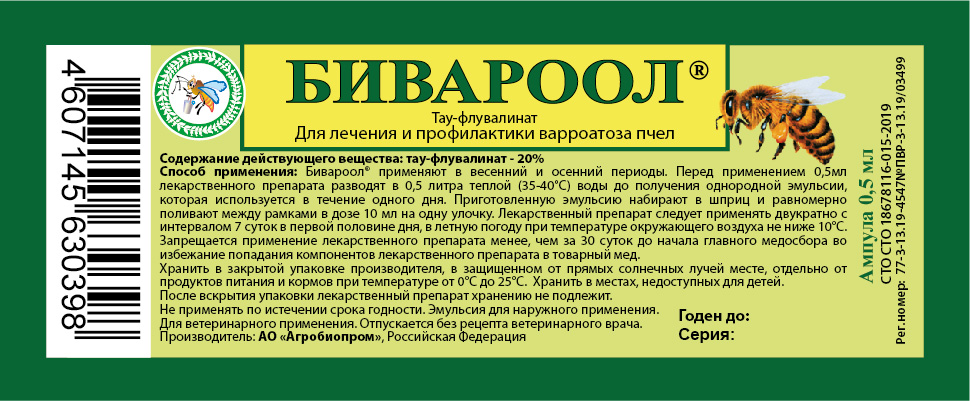

Bivarool contains in 1 ml as active ingredients: tau-fluvalinate – 20% and excipients
The drug is made in the form of white emulsion.

Bivarool belongs to the pharmacotherapeutic group of acaricidal drugs.
The synthetic pyrethroid (tau-fluvalinate), which is part of the drug, has a pronounced contact acaricidal effect against the causative agent of varroatosis of honey bees, the Varroa destructor mite. Tau-fluvalinate mechanism of action is to block the transmission of nerve impulses, which causes impaired coordination of movements, paralysis and death of mites.
The use of Bivarool does not cause the emergence of resistant tick populations.
According to the degree of exposure to the organism, Bivarool refers to low-risk substances, in recommended doses, it does not have a locally irritating and sensitizing effect.
Bivarool is not toxic to bees, in recommended doses it does not adversely affect the vital activity and productivity of colonies.

Apply Bivarool in spring and autumn. Before use, dilute 0.5 ml of the drug in 0.5 liter of warm (35-40 °C) water until a homogeneous emulsion is formed. Use within one day. Draw the prepared emulsion into a syringe and pour it evenly between the frames at the rate of 10 ml per beeway. Apply the drug twice with an interval of 7 days before noon, when the sky is clear, at an ambient temperature of at least 10 °C.
Do not use the drug less than 30 days before the start of the major honey collection to avoid the penetration of the drug components into marketable honey.
When using a product, the general rules of personal hygiene and safety provided for when using drugs should be observed. Empty packaging from under the drug is prohibited to be used for household purposes, it is subject to disposal with household waste.
In case of accidental contact of the drug with the skin or mucous membranes of the eyes, they must be rinsed with plenty of water.
People with hypersensitivity to the components of the drug should avoid direct contact with it. In case of accidental contact of the drug with the skin or mucous membranes of the eyes, they must be rinsed with plenty of water. In case of allergic reactions or accidental ingestion of the components of the drug into the human body, you should immediately contact a medical institution (take the instructions for use or label with you).

Adverse reactions and complications when using the drug in accordance with the instructions for use, as a rule, are not observed.
Symptoms of drug overdose in bees have not been established.
Bivarool should not be used in conjunction with other acaricidal medications.
The specifics of the drug's action at the first intake or when it is canceled have not been established.
NB! Avoid the prescribed dosage and prescribed administration pattern violations, as this may lead to suboptimal effectiveness. If the next drug dose is missed, it should be administered as soon as possible in the same dose, according to the same pattern.
Honey is allowed to be used for food purposes no earlier than 30 days after the end of the use of the drug in accordance with this instruction.

Bivarool is produced packaged, 0.5 ml (5 doses) in glass vials packed into individual polymer blisters.

Store the drug in the original unopened container, in a place protected from direct sunlight, separately from food and feed, at a temperature of 0 to +25 °C.
Keep out of reach of children. Use immediately after opening the package. The unused drug is disposed of in accordance with the requirements of the legislation.

The drug shelf life, subject to compliance with storage conditions in the original unopened container, is 3 years from the date of manufacture. Do not use the drug after the expiration date.
After opening the package, the product is not subject to storage.

