

Main
—
Catalog
—
For bees
—
Veterinary drugs
—
Bee acarapidosis and varroatosis treatment and prevention drugs
—
Tropigel
Tropigel
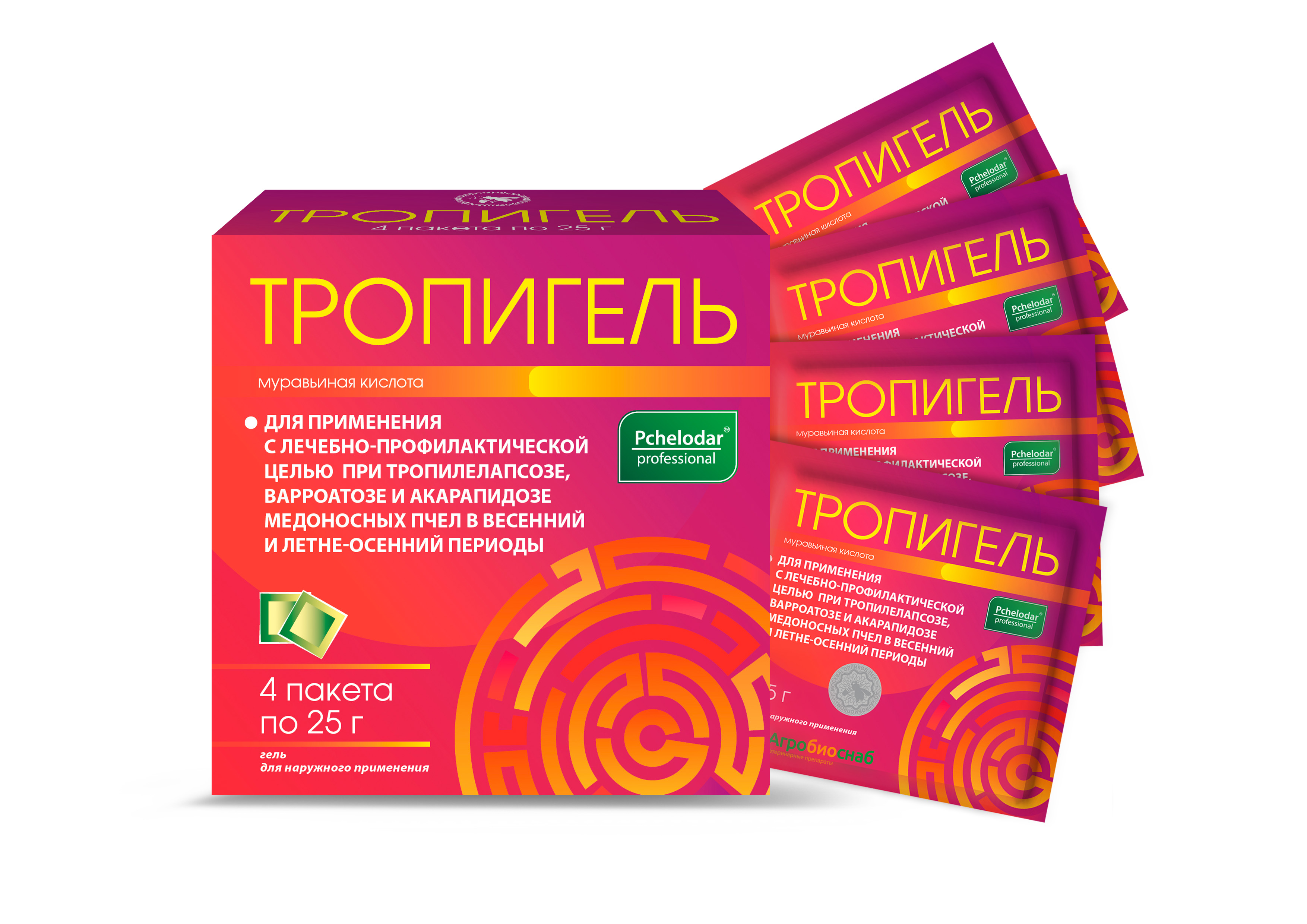

Dosage form: gel for external use.
Tropigel as an active ingredient contains: formic acid - 40% (in terms of 100% substance), and excipients.
In appearance, the drug is a gel-like mass from colorless to light gray in color with a pungent odor of formic acid.

Tropigel belongs to the pharmacotherapeutic group of acaricidal drugs.
Formic acid has an acute acaricidal effect, effectively destroys female and male ticks of the species Tropilaelaps spp. and Varroa spp., parasitizing the brood of honey bees and adult bees. It is active against the tracheal bee mite Acarapis Woodi.
The use of Tropigel does not cause the emergence of resistant tick populations in bee colonies.
Tropigel, according to the degree of exposure to the body, belongs to moderately dangerous substances (hazard class 3 according to GOST 12.1.007-76), has a locally irritating effect on the skin, mucous membranes and conjunctiva of the eyes.
The drug is non-toxic to bees, in recommended doses does not adversely affect the vital activity of bee colonies, does not accumulate in bee products.

The treatment of bee colonies with a medicinal product is carried out in the spring: with tropilelapsosis - after the beginning of oviposition by the queen bee, with varroatosis and acarapidosis - after a mass flight of bees, as well as in the summer and autumn period after pumping commercial honey at ambient temperatures from 12 °C to 30 °C.
Good ventilation should be provided in bee colonies treated with Tropigel.
The secondary packaging is opened and the package is removed.
A package made of metallized film.
In a bag of metallized film, 4 holes are made with a diameter of about 0.5 cm and placed at the bottom of the hive with holes facing up.
The package is made of acid-permeable non-woven material.
A bag made of acid-permeable non-woven material is placed on the upper bars of the honeycomb frames under the canvas.
Tropigel is used at the rate of: 1 package (25 g of the drug) per family with a strength of 5-7 beelines, 2 packages (50 g of the drug) per family with a strength of 8-14 beelines (packages are placed at a distance of 15-20 cm from each other). The packages are left in the hives for a period of 7 days, then removed and immediately replaced with new ones. New packages are left in the hives for a period of 7 days, after which they are removed and disposed of.
If ticks are re-detected in the hives 10 days after the completion of the treatments, additional treatment is carried out by placing 1 or 2 packages of Tropigel in the hive (depending on the strength of the family) and leaving until the drug completely evaporates.
If ticks are found in at least one family that was previously safe from tick infestation, preventive treatment is carried out on all hives that were not previously treated with the drug, placing 1-2 packages of Tropigel in the hive and leaving until the drug completely evaporates.
Upon completion of the treatment of hives with Tropigel, it is necessary to carry out measures aimed at restoring the health and normal functioning of bee colonies, including the use of special medicines, feed additives and feeds that stimulate oviposition, strengthen the immunity of bees, reduce toxicosis, improve the quality of brood containing vitamins, including succinic and ascorbic acid, as well as essential amino acids.

Side effects and complications in bees when using the drug in accordance with this instruction, as a rule, are not observed.
In case of an overdose of the drug, anxiety and the expulsion of bees from the hives may be observed.
It is not recommended to treat bee families with a strength of less than 5 beelines.
There is no information about the incompatibility of the drug with other drugs and feed additives.
It is not recommended to use Tropigel simultaneously with other acaricidal drugs.
The specifics of the drug's action during its first use or cancellation have not been established.
Violations of the doses and course of use of the drug should be avoided, as this may lead to a decrease in its effectiveness. If you miss the next use of the drug, it should be applied as soon as possible in the same dose according to the same scheme.
Honey obtained from bee families treated with Tropigel in accordance with this instruction is used without restrictions.

The drug Tropigel is produced packaged in 25 g in hermetically sealed bags made of metallized or polymer film or in bags made of acid-permeable non-woven material, packed in 4, 8, 12, 16 and 20 pieces in polymer cans (containers) or in cardboard packs.
Each consumer package is provided with instructions for use.

The drug is stored in the manufacturer's closed packaging, in a place protected from direct sunlight, separate from food and feed, away from heating devices and open flames, at a temperature from 0 °C to 30 °C.
The drug should be kept out of reach of children.
The unused drug is disposed of in accordance with the requirements of the legislation.
The drug is dispensed without a prescription from a veterinarian.

The shelf life of the drug, subject to storage conditions in the manufacturer's closed packaging, is 2 years from the date of manufacture.
It is forbidden to use the drug after the expiration date.
After opening the package, the drug is not subject to storage.
Buy with this product
New!

Release form:
Aerosol.
Application:
For decontamination, disinfection and disinfection of honeycombs, beehives and beekeeping equipment