

Sanacard, drops on the withers for large breed dogs and puppies PLUS
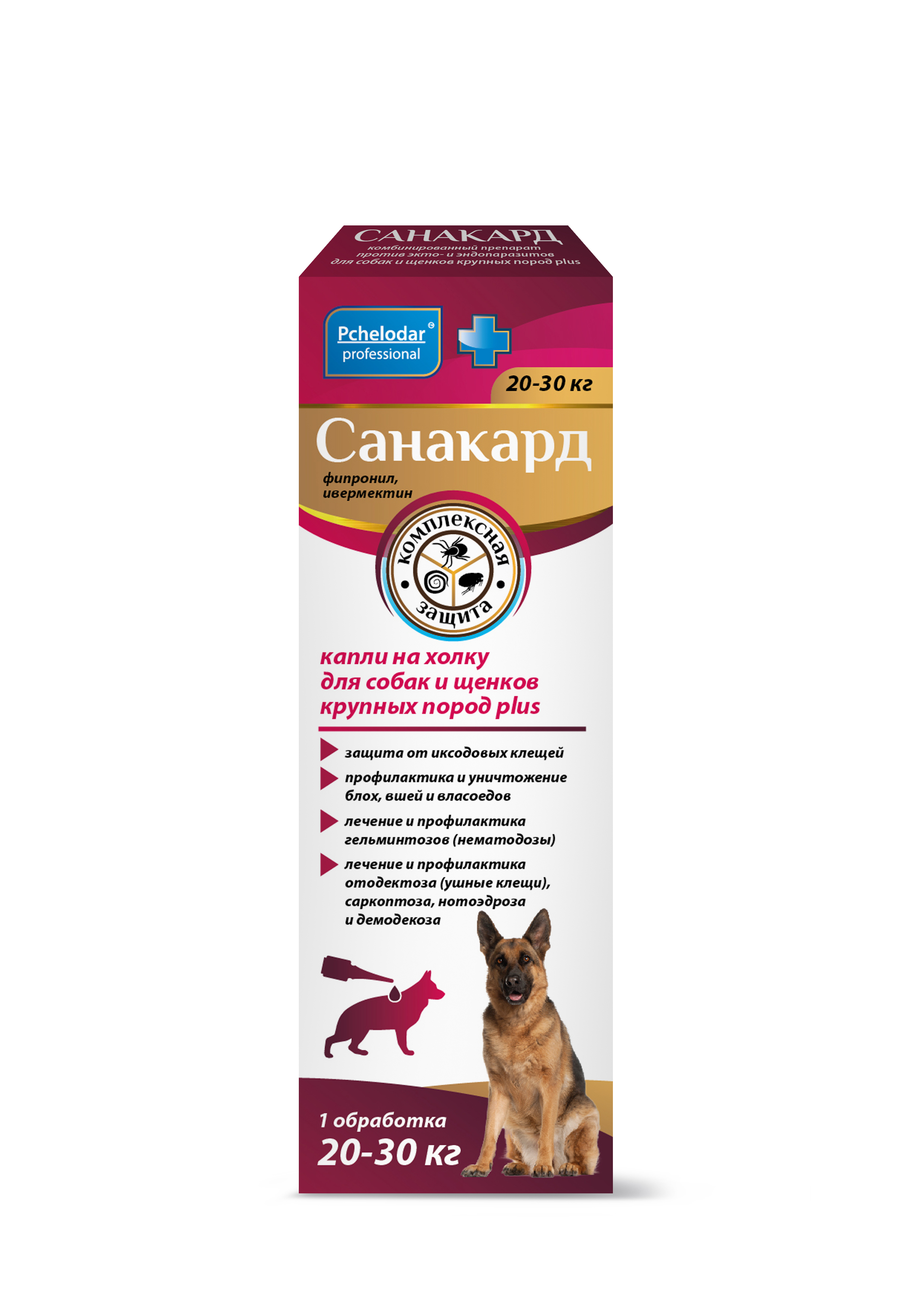
Registration number: 77-3-20.20-4710No.PVR-3-20.20/03592 International nonproprietary name: fipronil, ivermectin.

The drug Sanacard in 1 ml contains as active ingredients: fipronil - 90 mg, ivermectin - 30 mg, and as excipients: gasoline alcohol, dimethyl sulfoxide, agidol-1, citric acid, polyethylene glycol-400.
The drug is made in a form of a transparent light yellow oily liquid.
Dosage form:
Solution for external use.
Pharmacotherapeutic group:
Antiparasitic agents.

The active substances included in the drug have a contact and systemic antiparasitic effect on the sexually mature and larval phases of the development of fleas (Ctenocephalides canis, Ctenocephalides felis), lice (Linognathus setosus), hair eaters (Trichodectes canis, Felicola subrostratus), ear mites (Otodectes cynotis), ixodid mites (Ixodidae), mosquitoes (Aedes aegupti) and nematodes (Toxocara spp., Toxascaris spp., Trichuris vulpis, Uncinaria stenocephala and Ancylostoma spp.), parasitic in dogs and cats. The mechanism of action of ivermectin is its effect on the amount of chlorine ion current through the membranes of nerve and muscle cells of the parasite.
The main target is glutamate-sensitive chlorine channels, as well as gamma-aminobutyric acid receptors. A change in the current of chlorine ions disrupts the conduction of nerve impulses, which leads to paralysis and death of the parasite. The mechanism of action of fipronil, which is part of the drug, consists in blocking GABA-dependent ectoparasite receptors, disrupting the transmission of nerve impulses, which leads to paralysis and death of insects and ticks. When applying the drug to the skin, fipronil is practically not absorbed, ivermectin is partially absorbed into the systemic circulation.
Fipronil and ivermectin accumulate in the epidermis, hair follicles, sebaceous glands and have a long-term contact insecticidal effect. Ivermectin entering the systemic circulation also has a systemic nematocidal effect. A single treatment of the animal with Sanacard ensures the destruction of fleas and ticks within 24-48 hours. The protective effect of the drug against ticks lasts up to 4 weeks, against insects - 4-5 weeks. The maximum concentration of ivermectin in the blood after ingestion of the drug into the animal's organism is reached after 4 hours. Ivermectin is excreted from the animal's organism with urine and bile.
According to the degree of exposure to the body, Sanacard belongs to moderately dangerous substances, in recommended doses, it does not have a locally irritating and sensitizing effect.
Sanacard is used in dogs and cats as the treatment and preventive care in the following cases:
- acariasis (infestation with hard ticks [the Ixodidae], sarcoptic mange, notoedrosis, demodicosis, otodectosis, and сheyletiellosis);
- entomosis (fleas, lice, and Trichodectidae);
- nematodes

|
Animal weight |
For large breed dogs PlUS (1.5 ml pipettes) |
|
20-30 kg |
2 |
|
When treating dogs weighing more than 40 kg, the drug is used at the rate of 1 ml for every subsequent 10 kg of pet weight. |
|
Sanacard is used by applying to the dry undamaged skin of the animal in places inaccessible for licking. The treatment of animals is carried out outdoors or in a well-ventilated room. Before use, the tip of the pipette is cut off, the wool is pushed apart and the drug is applied drip in the neck area at the base of the skull or between the shoulder blades, at 3-4 points. The dosage of the drug depends on the type and weight of the animal.
The minimum therapeutic dose is 0.1 ml per 1 kg of animal weight. Do not wash or bathe the animal within 48 hours after treatment. During treatment, it is necessary to avoid getting the drug on the mucous membranes of the animal.
To destroy ixodic ticks, fleas, lice and hair eaters, the animal is treated once, to prevent re-invasion - once per month throughout the entire season of parasite activity. In order to prevent re-invasion, animal litter is replaced or treated with insecticidal agents in accordance with their instructions for use.
In case of otodectosis (ear scabies), the treatment of the animal with a drug is carried out once. In addition, 1-3 times a week for 5-14 days, the animal's auricles are cleaned of exudate, pus and tick waste products with or without the use of hygiene products, and in case of complications with otitis media, antimicrobial and anti-inflammatory drugs are used as prescribed by the attending veterinarian. If necessary, the course of treatment is repeated after 1 month.
In case of sarcoptosis and demodecosis of dogs, the drug is used for therapeutic purposes 2-4 times with an interval of 14-20 days; for preventive purposes - once a month.
In case of nematodoses, the drug is used for therapeutic purposes once, for preventive purposes - once per quarter. In the treatment of animals with parasitic diseases, it is recommended to disinfect and disinfect the places where animals are kept in order to avoid re-infection.
The specifics of the drug's action during its first use and cancellation have not been established. Violations of the drug regimen should be avoided, as this may lead to a decrease in its effectiveness. If the next treatment is missed, it should be carried out as soon as possible in the same dose and according to the same scheme.

The specifics of the drug's action during its first use and cancellation have not been established. Violations of the drug regimen should be avoided, as this may lead to a decrease in its effectiveness. If the next treatment is missed, it should be carried out as soon as possible in the same dose and according to the same scheme.
Side effects and complications when using the drug in accordance with this instruction, as a rule, are not observed. With increased individual sensitivity and the appearance of allergic reactions, the drug should be washed off with water and detergent and, if necessary, antihistamines and symptomatic therapy should be prescribed to the animal.
Contraindication to use is an increased individual sensitivity of the animal to the components of the drug (including in the anamnesis). Auricular use of the drug is not allowed in case of perforation of the eardrum. The drug should not be used for dogs weighing less than 2 kg. Sanacard should not be used in animals younger than 8 weeks of age. It is forbidden to use the drug to pregnant and lactating females, weakened, suffering from infectious diseases and recovering animals.
With an overdose of the drug, animals may experience depression, weakness, tremor, excessive salivation. There are no specific means of detoxification. Apply general measures aimed at removing the drug from the body.
Sanacard should not be used simultaneously with avermectin-containing and other antiparasitic drugs due to a possible increase in toxicity. It is allowed to be used together with anti-histamine, anti-inflammatory and antibacterial drugs according to indications, under the supervision of a veterinarian.
Due to the pronounced breed sensitivity to avermectins, the drug should be used with caution to dogs of collie, bobtail and sheltie breeds. For weakened and old animals, Sanacard is used under the supervision of the attending veterinarian. The drug is not intended for use by food-producing animals.
When using a product, the general rules of personal hygiene and safety provided for when using drugs should be observed. Smoking, drinking and eating are prohibited during the usage. Empty packaging from under the drug is prohibited to be used for household purposes, it is subject to disposal with household waste. Treatment of animals should be carried out in rubber gloves. At the end, wash your hands thoroughly with warm water and soap. Animals should not be petted or allowed near small children for 48 hours after treatment.
People with hypersensitivity to the components of the drug should avoid direct contact with it. In case of accidental contact of the drug with the skin or mucous membranes of the eyes, they must be rinsed with plenty of water. In case of allergic reactions or accidental ingestion of the components of the drug into the human body, you should immediately contact a medical institution (take the instructions for use or label with you).

The Sanacard drug is produced packaged in 1.5 ml in polymer pipettes of appropriate capacity, packed in 2 pipettes in individual cardboard packs. Each consumer package is provided with instructions for use and stickers for a veterinary passport.

Store the drug in the original closed package, protected from direct sunlight, separately from food and feed, at a temperature of 0 to +25°C.
The unused drug is disposed of in accordance with the requirements of the legislation.

The shelf life under storage conditions in the original closed package is 2 years from the manufacturing date. Do not use after the expiration date.
Keep out of reach of children!
It is released without a prescription from a veterinarian.

Release form:
Suspension for oral use
Application:
Combined anthelmintic agent